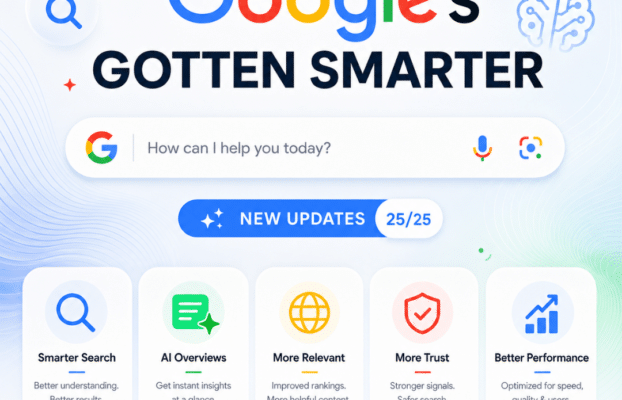
So, Google’s changed how it works. Again.
If you run a dental practice, you might be thinking, “Great, does this actually help get more patients through the door?” Good question. The short answer is yes, if you understand what is going on.
Let’s walk through it in plain English. No waffle, just what you need to know to stay ahead.
01.First, Let’s Look at Old Google vs New Google
Old Google was slightly simple. Yes, in the mean sense. You would type “teeth whitening Leeds” and it would look for pages that said those exact words over and over. If your website had that phrase stuffed into every paragraph, you had a shot.
Now, Google has grown up. It has gone from word-matcher to mind-reader. Instead of just checking if you said “teeth whitening”, it is trying to figure out what people really want.
Are they comparing options? Wondering about cost? Looking for before-and-after photos? Hoping it does not hurt?
This new system breaks a search into lots of little questions. So “Is Invisalign worth it for crowded teeth?” gets read more like this:
Are they interested in Invisalign?
Google understands the treatment topic, not just the exact words.
Do they care about price or value?
“Worth it” suggests they are comparing cost, outcome and benefit.
Do they have a specific issue?
“Crowded teeth” tells Google the patient has a particular concern.
Are they worried about results or comfort?
Google can connect the query to common patient anxieties.
If your website answers all of those, bingo. You are much closer to what Google wants. But there is more to it than that, so FAQs alone will not cover it.
02.Google’s Also Doing This to Your Website
Here is where it gets interesting. Google is not just smarter about searches. It is also slicing and dicing your content in the same way.
Say your site has a page about dental implants. You have:
- A section explaining how long they last.
- A few lines about cost and who they are for.
- A mention that they help you chew properly again. Classic, but true.
Each of those is now treated like its own mini-topic. So when someone searches “Are dental implants worth it for back teeth?”, Google does not just look for the words “dental implants.” It checks whether you have covered:
The value side
Does your page explain why treatment may be worth the investment?
Molar suitability
Does your content discuss back teeth, chewing and practical function?
Eating confidence
Does it help the patient understand whether they can chew properly again?
If your site ticks all the boxes, you have a real chance of ranking. If it is all fluff and vague marketing speak, you are probably invisible.
03.Say Hello to MUVERA
Google’s name for this clever new system is MUVERA, short for Multi-Vector Retrieval. Sounds like something from Star Trek, never seen it but I know the gist, but do not worry. You do not need to know the techy bits.
What matters is this:
- Google now breaks searches and websites into lots of mini-topics.
- It matches those mini-topics quickly and cleverly.
- You do not need to be a tech wizard to take advantage.
04.Behind the Scenes, Still Simple, Promise
Here is the nerdy bit, made simple.
When someone searches something, or when Google reads your site, it turns the content into “vectors”, basically number versions of ideas.
But now, instead of one big blob, it creates lots of little ones:
- One for price.
- One for benefits.
- One for location or suitability, such as back teeth.
- One for emotional stuff like “worth it”.
Then it plays a big game of data matchmaking. Your website’s blobs either match the search blobs, or they do not.
05.Why This Matters for SEO, Especially SEO for Dentists
This is big for dental SEO. Here is what it means in practice:
- Keywords alone will not cut it anymore.
- You need to answer full questions, not just drop in the words “teeth whitening” and hope for the best.
- Your content should cover all the angles a patient might care about, not just the clinical stuff, but comfort, cost and confidence too.
In other words, write like you are helping a patient understand their options, not like you are writing a brochure.
Google Search Console is already showing more focus around topics and trends instead of just plain keywords. That is your nudge: write about real ideas, not just buzzwords.
We have already had a few principal dentists who are “down with the kids” ask how they can appear in the Gemini AI summary that comes up when someone searches a treatment in a city or region. And that is exactly what this update is slowly building towards. You guessed it, AI.
In what capacity, no one is completely sure yet. It has always been best practice to stick to what you know. That means following the latest guidance and updates one at a time.
06.How Your Treatment Pages Should Look Post-Update
Your treatment pages are going to need to be a lot more in depth. If you are getting quoted for an SEO-ready website, and it is actually being done by someone who knows what they are doing, rarer than you may think, then the price increase should be noticeable.
Here is the ideal page structure:
1. Patient-first intro
Explain the treatment simply, who it helps and why someone might be considering it.
2. Suitability
Cover who the treatment is right for, who it may not suit and when a consultation is needed.
3. Cost and value
Give useful price guidance, finance information and what affects the final cost.
4. Comfort and anxiety
Explain whether it hurts, how patients are kept comfortable and what nervous patients should know.
5. Results and expectations
Discuss realistic outcomes, timelines, limitations and maintenance.
6. Local relevance
Make it clear where you provide the treatment and why your practice is trusted locally.
7. FAQs
Answer the exact questions patients search, but do not rely on FAQs alone.
8. Clear next step
Make the enquiry route obvious with phone, form, WhatsApp or booking options.
Want SEO-ready treatment pages built properly?
Wise helps dental practices build treatment pages that answer patient questions, support local SEO and make your practice easier for Google to understand. WhatsApp Us →
07.The Final Word
Google has stopped being a parrot. “You said Invisalign? Here is Invisalign.” It has started acting more like a smart receptionist. “Ah, you are worried about cost, crowding and visibility. Let me point you to the best info.”
If your website content only scratches the surface, you will get left behind. But if you treat each page like a proper, helpful guide, written for real people with real questions, you are exactly what Google is looking for.
This is the new way SEO for dentists works. And if you are not building for it, you are not really playing the game.
Written by Kieran Standen, founder of Wise Agency and recognised expert in dental marketing.